[DEF - Main Content]
Scholarship Dinner Celebrates Donor Impact, AddRan College Innovation
 |
As TCU grows to meet the rising number of students who aspire to be Horned Frogs, the need for endowed scholarships also increases. In fact, for many current and prospective students, scholarship support is the determining factor in whether they can achieve their dream of attending TCU.
That was the message students, donors, TCU Trustees, alumni, faculty and staff heard at the 36th Annual Scholarship Dinner in Schollmaier Arena. In attendance were many of the TCU students who were matched to named endowed scholarships this year, as well as the donors who made those scholarships possible.
The evening opened with an invocation from Sameep Shah ’26, a senior majoring in computer science and economics, and recipient of the Clark Society Endowed Scholarship. A native of India and AddRan Ambassador, Shah set a reflective tone for the evening, asking attendees to consider the power of generosity and the responsibility that comes with education.
Chancellor Daniel W. Pullin referenced LEAD ON: Values in Action when explaining the importance of endowed scholarships. “Scholarships impact all four pillars of our bold strategic plan ... student-centered growth; research, scholarship and creative activities; athletics; and community engagement.”
TCU students with endowed scholarships can focus less on paying for college and more on building the knowledge and confidence they need to make a positive impact in the world, he added.
“Endowed scholarships are critical to our mission and vision: they encourage promising and exemplary students, who need and have earned our support, to fulfill their potential.”
Don Whelan, vice chancellor for University Advancement, recognized 24 new scholarships that were awarded for the first time during the 2025-2026 academic year as well as donors of the 26 endowed TCU scholarships that will be awarded for the first time during the 2026-2027 academic year.
Focusing on Innovation in the AddRan College of Liberal Arts
The evening also offered a look at the inspiring work happening across AddRan College of Liberal Arts, from faculty research shaping important conversations to student scholars already making marks in their fields.
Dr. Sonja Watson, dean of AddRan College, introduced two endowed scholarship recipients who discussed their experiences, and a panel featuring community leaders and an endowed scholarship recipient who will work on Capitol Hill next fall. “At TCU, we prepare liberal arts students for a job, and we prepare them for a lifetime of thinking critically, communicating clearly and adapting confidently in a world that is constantly changing,” she explained. “One way we accomplish this is by remaining ahead of the curve and adopting innovative technologies.”
“By combining technical training with liberal arts inquiry, it prepares graduates to meet workforce demands with marketable competencies while also fostering ethical, cultural and social awareness,” she added.
Gabriella Campos ’26, a recipient of the Priscilla W. Tate Scholarship who majored in computer information technology, discussed working on an episode of History Frogcast, a history department podcast that allows students to tackle a range of topics and is entirely researched, written and produced by them. Her podcast delved into the story of Lt. Dorothy Delmar, a World War II flight nurse who treated both Allied and Nazi soldiers.
“I spend most of my time in a very technical world. A lot of what I do is focused on systems, logic and problem-solving,” Campos explained. “The History Frogcast gave me the chance to tell a story, but more importantly, it taught me how to listen to the past, to other perspectives and to ideas that don’t always feel comfortable at first. ... It changed the way I approach learning, communication and even my own field.
“That’s what TCU has taught me to do. To think deeper, to sit with complexity and to lead with understanding, even when it’s uncomfortable.”
Olivia Dugger ’25, past Chancellor’s Scholar and recipient of the Clarence and Loreen Angle Memorial Scholarship, earned degrees in geography, Italian and digital culture and data analytics at TCU. She’s now an associate technical consultant at Esri, a leading geospatial technology company.
Before that, she was one of four undergraduates mapping climate stories — StoryMaps — for Patagonia Books.
“That project felt like a culmination of everything I’d been building at TCU — working across disciplines, collaborating with both team members and clients, and diving deep into unfamiliar territory — all coming together in one place,” she explained.
“Working with these Patagonia published authors, it didn’t feel like your typical university internship — it felt like we were already out in the world. We were working with published experts, who trusted the four of us to tell their stories in a new and exciting way. That meant asking them the right questions, translating the need behind the want and figuring out how best to deliver the end products. At the same time, the research side of it pushed us to really delve into and understand unfamiliar topics to represent them truthfully in our deliverables.
“Working together pushed me to think beyond the technical side and focus on how to make complex data accessible and the story behind it clear.”
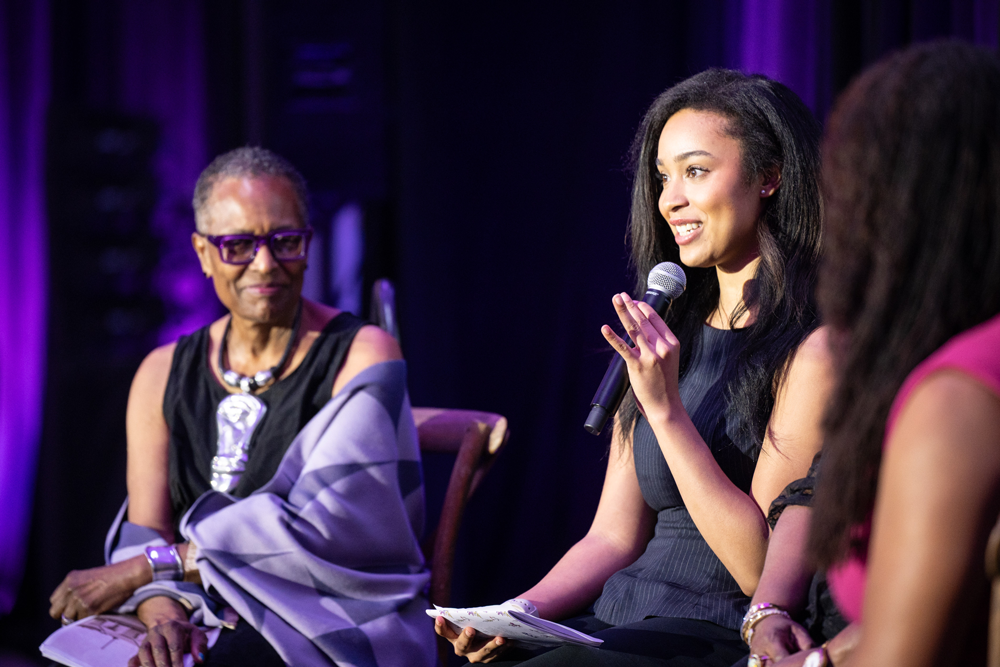
The program ended with a panel discussion led by Dr. Stacie McCormick, associate professor of English and chair of comparative race and ethnic studies and women and gender studies at TCU. Participants included the co-founders of The Renaissance House, Dr. Jennifer Giddings Brooks ’71 (MS ’74), educational executive and community leader; and Marnese Elder, CEO and founder of Mecca Management Solutions, LLC.
The Renaissance House, located at 1201 E. Terrell Ave in Fort Worth’s Historic Southside, is a community hub focused on preserving Black history and culture and improving local health outcomes. It collaborates with TCU on initiatives like the AddRan College of Liberal Arts health symposia and internship programs, addressing health disparities in the 76104 ZIP code. The center aims to revitalize the Historic Southside by focusing on social determinants of health and showcasing community history.
Also participating in the panel was Winter L. Harris ’26, recipient of the Natalie E. Fort Endowed Internship Fund, a strategic communications major with minors in comparative race and ethnic studies and political science. Through a grant-funded research project secured by Dr. McCormick, undergraduate students like Harris had the opportunity to support The Renaissance House through digital preservation and storytelling. This experience not only allowed Winter and others to contribute meaningfully but also deepened their understanding of how support of community-driven initiatives can create lasting impact.