[DEF - Main Content]
2026 Celebration of Philanthropy Showcases Student, Faculty Research on the Road to R1 Status
 |
Texas Christian University faculty and students recently spent an evening showing university donors how their transformative support is making extraordinary scholarly journeys possible and advancing groundbreaking research, scholarship and creative activities that elevate TCU’s impact and national reputation.
The 2026 Celebration of Philanthropy also honored TCU’s Chancellor’s Council members and Clark Society donors who had achieved a new lifetime giving recognition level and recognized the establishment of the J. Luther King, Jr. Endowed Chair in Finance.
The Luther and Teresa King Family Foundation established the chair in the Neeley School of Business in 2025. The position enables the Luther King Capital Management Center for Financial Studies to attract and retain outstanding leaders. A two-time TCU graduate, Luther King has provided inspiring leadership and service to his alma mater as a TCU Trustee, as chairman of the Board from 2005 to 2011, and as a long-time member of the Neeley School’s Board of Advisors.
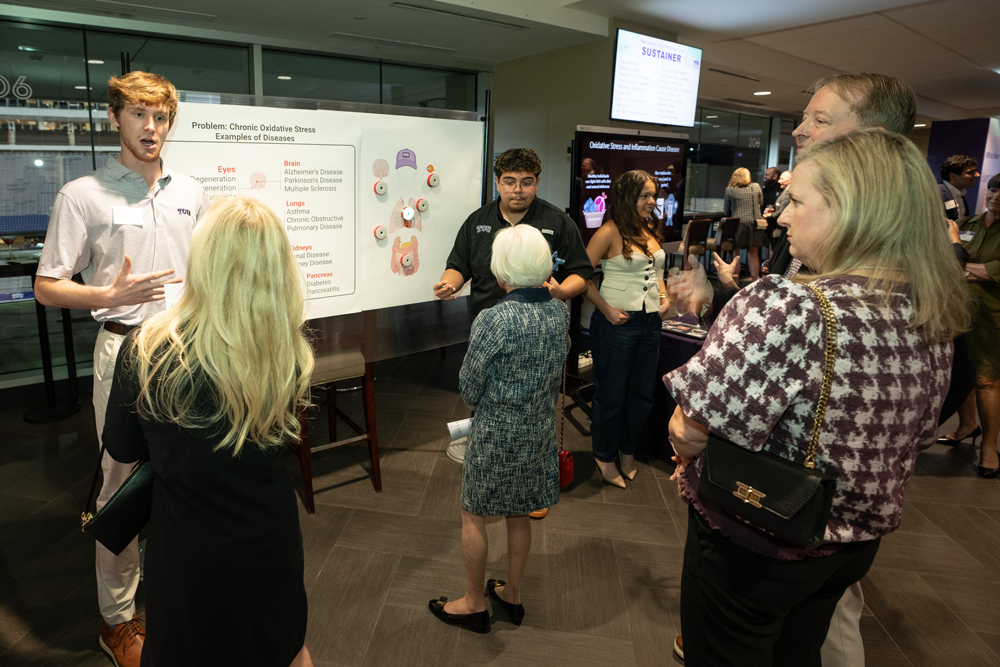
A highlight of the evening was interactive research stations showcasing multidisciplinary research and scholarship across campus. These exhibits featured both graduate and undergraduate students working alongside faculty to demonstrate the importance of research that supports everything from NASA space exploration missions and future orbital technologies to research that improves prosthetic care for people with limb loss and limb differences.
The goal, explained Dr. Reuben Burch, TCU vice provost for research, is to propel TCU toward a Research 1 (R1) designation in the Carnegie Classification of Institutions of Higher Education. He thanked TCU faculty members who helped the university increase its external competitive research awards by over 50 percent from fiscal year 2025.
“R1 is really about … people,” he said. “It’s our researchers who love to solve their own impossible problems while giving their all to the students who will benefit by having research and applied learning infused into the classroom. Being R1 is about competing for big ideas, funding and award recognition, signaling to the rest of the country we have world-class research talent here at TCU.”
Dr. Kayla Green, chemistry professor and assistant dean of undergraduate affairs at TCU’s Louise Dilworth Davis College of Science & Engineering, operated an interactive station with her students centering on developing small molecules for use as therapeutics for diseases caused by oxidative stress and novel catalysts for challenging hydrocarbon transformations. Her team also leads nationally recognized STEM education outreach programs, including Chemistry Connections, which has reached over 30,000 visitors in the DFW area.
“As a researcher, it is easy to stay in our little research bubbles and only think of the day-to-day lab work,” Green said. “However, getting to interact with those who love TCU as much as I do and tell them about the research that my students are doing was so rewarding. They were excited and wanted details about the process. They know those details matter and had great feedback and ideas on how to move forward.”
Students working with Dr. Robyn Trocchio, associate professor of kinesiology, graduate program director for kinesiology, and director of the TCU Sport and Exercise Psychology Lab, shared insights on how psychological factors influence physical activity, exercise adherence and human performance across diverse populations.
“It’s energizing to share how our research translates beyond the lab into real-world impact with leaders who care deeply about the future of TCU and our students,” Trocchio said.
At another station, students working with Dr. Omar R. Harvey, geology professor and director of the TCU Natural Resources Research Initiative, engaged with research exploring Earth as an integrated system, examining dynamic interactions between organic compounds and minerals with applications in food security, water resources, critical minerals, energy systems and environmental sustainability.
“It’s a blessing that my research is rooted in issues — water, food and community resilience — that are central to the success or failure of societies,” Harvey said. “Our students also care deeply about these issues, making it easy to bring research into the classroom...
“In my view, R1 is more than the obvious prestige; it’s about strengthening our teacher-scholar model toward keeping our students competitive to continue to lead and innovate,” he concluded. “The expansion in access to the cutting-edge research R1 provides will improve our mentoring and expose students to modern tools and methods.”